🎆 A New Year for California Property Owners (Yes, Really)
If you own real estate in California, you’ve been trained—almost Pavlovian-style—to brace yourself every January. New year usually means new rules, new fees and new ways to be told “no.”
So let’s acknowledge the obvious right up front:
Most property owners didn’t ask for more laws.
And yet… 2026 quietly feels different.
Not easy. Not simple. But different in a way that matters.
For the first time in years, many of the new laws aren’t about restriction — they’re about clarity, predictability and options. And in real estate, options are power.
No, this doesn’t mean everyone should start building tomorrow.
But it does mean your property may no longer be boxed in the way it was even two years ago.
That alone is worth paying attention to.
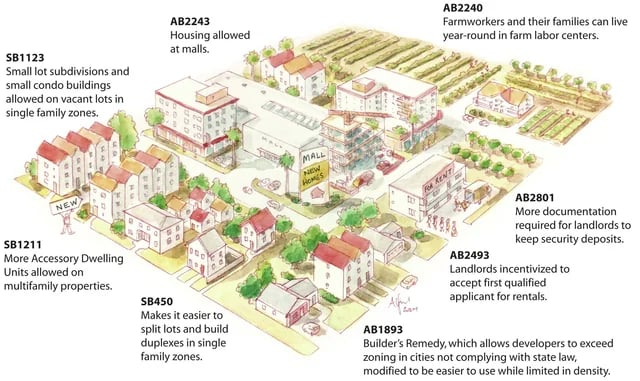
🏘️ SB 9: The Law That Didn’t Blow Up Neighborhoods — and That’s the Point!
SB 9 has been one of the most misunderstood housing laws in California history.
Depending on who you asked, it was either:
- The end of single-family neighborhoods 😱
- Or the silver bullet that would solve the housing crisis overnight 🦄
Neither happened.
And honestly? That’s why SB 9 works.
What SB 9 Actually Allows
SB 9 gives qualifying urban single-family properties two major rights:
- Urban lot splits (one lot becomes two)
- Two primary units per lot
When combined correctly, this can mean up to four homes where one used to exist.
But—and this matters—SB 9 is ministerial:
- No public hearings
- No neighbor votes
- No discretionary delays
If you meet objective standards, the city must approve.
That’s the real shift.
Not density everywhere — certainty somewhere.
The Positive Nobody Talks About
Even if you never build a single wall, SB 9 gives you something California property owners rarely get:
➡️ Leverage
- Leverage in appraisals
- Leverage in future planning
- Leverage when deciding whether to sell, hold, or refinance
Optionality adds value, even when unused.
Yes, There Are Guardrails (And That’s Okay)
SB 9 isn’t a free-for-all:
- Owner-occupancy affidavits for lot splits
- Minimum parcel sizes
- Anti-displacement rules (no recent tenant evictions)
Let’s be honest — without guardrails, this law never would’ve survived.
The upside? You now know the rules before you spend money exploring an idea.
🛠️ SB 450: Why SB 9 Finally Has Teeth in 2026
After SB 9 passed, many cities responded creatively… and not in a good way.
Some tried:
- Oversized setbacks
- SB 9–only design standards
- Endless “correction letters”
SB 450 shut that down.
What SB 450 Fixes
- ⏱️ 60-day approval or denial clock
- 📋 Objective standards only
- 🧭 Clear explanations required for denials
- 🏛️ Applies to charter cities too
Translation: cities can’t stall forever anymore.
Why This Is a Big Deal
Real estate projects don’t usually fail because of construction.
They fail because of time uncertainty.
SB 450 doesn’t force approvals — it forces decisions.
And in development, a clear “yes” or “no” is infinitely better than “maybe later.”
🚉 SB 79: Transit-Oriented Density (Mid-2026) 🚆
SB 79 recognizes something Californians already know intuitively:
Properties near major transit don’t function like other properties.
Starting mid-2026, qualifying sites near rail stations and high-frequency transit may allow:
- Higher residential density
- Reduced parking requirements
- Streamlined approvals
This doesn’t bulldoze neighborhoods.
It simply acknowledges reality.
The Hidden Upside
Even if you never redevelop:
- Zoning flexibility often shows up in land value
- Lenders and appraisers pay attention to future potential
Sometimes the biggest gains happen on paper long before they show up in concrete.
🏠 AB 1154 + SB 543: Why ADUs Finally Feel… Doable
Accessory Dwelling Units were pitched as a housing solution years before cities were actually prepared to approve them.
AB 1154 and SB 543 address the two biggest pain points:
- Occupancy Rules and Time.
AB 1154: Unlocking JADUs 🔓
If a Junior ADU has its own bathroom, owner-occupancy is no longer required.
That means:
- Long-term rentals allowed
- Owners don’t have to live on-site
- More flexibility for families and investors
Yes, short-term rentals are still restricted — and that’s intentional.
SB 543: Killing the “Permit Limbo” Problem
- 15 days to deem an application complete
- 60 days to approve or deny
- Fee limits for small units
- Clear size definitions (“interior livable space”)
It’s still work — but it’s finally predictable work.
Predictability is what turns “maybe someday” into actual projects.
🧯 HOA Fine Caps, Appliances and Smoking Disclosures
These changes won’t make headlines — but they’ll make life easier.
HOA Fine Caps 🏡
HOA fines are generally capped at $100 per violation, unless there’s a health or safety issue.
If you’ve ever opened an HOA letter with your heart racing, this one’s for you.
Appliance Requirements 🔌
Landlords must provide and maintain:
- A working stove
- A refrigerator (for new or amended leases)
Clear expectations = fewer disputes.
Smoking Residue Disclosures 🚭
Sellers must disclose known smoking or nicotine residue.
It’s not about punishment — it’s about transparency.
📝 Federal FinCEN Reporting: Real Estate Joins the Big Leagues
Starting March 1, 2026, certain non-financed residential transfers involving trusts or entities must be reported to FinCEN.
Most homeowners won’t feel this at all.
Investors using LLC's and trusts will need to adapt.
Real estate is being treated like financial infrastructure now — because it is.
🌅 The 2026 Real Estate Mindset Shift
2026 isn’t about rushing to build.
It’s about thinking differently about what you own.
More clarity.
More predictability.
More options.
And after years of “no,” that feels like progress.